
Invisalign and veneers look like rivals, and they almost never are, because each one answers a different question about your teeth: are they in the wrong place, or are they the wrong shape? Here is the lovely part: once you know which question your own smile is asking, the choice very nearly makes itself, and plenty of the best smiles turn out to use both.
Invisalign or veneers: which one does my smile need?
Picture a hallway of framed photographs. Some frames hang crooked, and one photo has faded in the sun. You would never reprint the photo to fix a crooked frame, or straighten a frame to bring back a faded photo. Each fix comes from what is actually wrong.
Your teeth work the same way. Invisalign moves teeth. It is a set of clear aligners, each made to your teeth from a 3D scan and each a fraction different from the last, and they walk your teeth, a little at a time, to where the plan puts them. Nothing is added and nothing is taken away, so the teeth that arrive in line are still entirely your own.
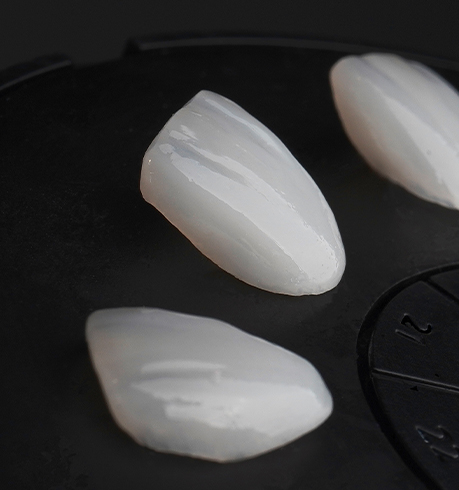
A veneer does a different job. It is a thin porcelain shell over the front of a healthy tooth, made to change its shape and shade. The crowns and veneers page at Designer Smiles puts the right teeth for it in one line: “Healthy front teeth whose shape, length or shade you want changed for the long term.” A veneer is bonded to the front of a tooth wherever that tooth happens to stand, so a tooth sitting forward of its neighbours keeps sitting forward, only now with a new face. That is why the same page adds, just as plainly: “Not when teeth need moving: Invisalign first.”
So the sorting is a friendly one. Teeth that are crowded, gappy, twisted or drifted since a teenage brace are aligner work. Teeth in a good line that you would love to see longer, reshaped or in a new shade for years to come are veneer work.
How do Invisalign and veneers compare, side by side?
Here are the two together, with composite bonding between them: tooth-coloured resin shaped onto your own teeth in one visit, the gentle middle way.
| Invisalign | Composite bonding | Porcelain veneers | |
|---|---|---|---|
| What happens to the tooth | Nothing added or removed; the teeth are moved | Resin added to the surface; nothing drilled away | A thin layer of enamel removed; a porcelain shell bonded on |
| Visits | Check-ins over months | Consultation, then one visit | Two or three |
| How long it lasts | For good, with retainers worn at night | Typically five years or more; a chip is repaired in one short visit | Ten to fifteen years; stain-resistant; the tooth always needs covering afterwards |
| Price here | £2,195 to £3,295 for the four full plans | £200 – £250 a tooth on the current offer (usually £400) | £800 a tooth |
| Best for | Crowding, larger gaps, a bite that is out | Chips, small gaps, worn edges, uneven lengths | Bigger shape and shade changes that need to last longest |
The first row tells the whole story. Invisalign changes where a tooth stands; bonding and veneers change what its front looks like. The composite bonding page sets the same three side by side, with a price on each.
Which is better for gaps between your teeth?
Well, it depends on the size of the gap.
A small gap between the front teeth is usually bonding’s job. The bonding page describes it as “closed by widening the teeth either side a fraction”, in one visit, with the teeth underneath left whole. The crowns and veneers page agrees from the other side: veneers are “Not when the change is small: a chip, a short edge, a slight gap.”
A larger gap is a question of where the teeth stand, and so is crowding. Invisalign closes gaps “by moving the teeth together”, so the space really goes and the teeth keep their natural width. You see, widening two teeth a long way to fill a big space would leave them looking broad, so for the bigger gaps, moving is the kind answer.
What do veneers ask of your teeth?
Veneers give you a great deal. Porcelain veneers last ten to fifteen years, because porcelain is a ceramic fired hard in a laboratory, so it keeps its shape and its gloss and shrugs off your morning coffee. Each one is designed on screen to your face from a 3D scan and made in a shade chosen against your other teeth.
And they ask one thing in return. Before a veneer goes on, a thin layer of enamel is taken from the front of the tooth so the porcelain can sit level with its neighbours. The crowns and veneers page explains why some dentists advise against veneers in exactly those terms: “a veneer means removing a thin layer of enamel that does not grow back, so the tooth will always need covering.” For a small change that is a poor trade, because bonding does the job without it. For a large, lasting change to healthy front teeth, the same page calls veneers “the right tool.”
The happy news is that you never take the result on trust. At Designer Smiles a trial smile is placed over your own teeth first, so you look in the mirror at your new shape and adjust it before anything is made. After that come two visits for the work itself, with the laboratory making the veneers in between, and a porcelain veneer here is £800 a tooth. Still weighing that trade? Whether veneers are worth it takes the question on its own, and the veneers page walks through every step from the scan to the fit.
What does Invisalign ask of you?
Invisalign asks for time and a little discipline, and it gives you back teeth that are entirely yours.
The time is months. Invisalign Lite runs four to six months, Moderate six to nine, and Comprehensive nine months and more, because teeth with further to travel need more aligners. The discipline is the wear time: twenty to twenty-two hours a day, out to eat and to drink anything other than water, then straight back in after a brush or a rinse. Think of a gardener’s tie on a young tree, which guides it only while it is tied on. And that is lovely news, because the biggest thing deciding your result sits in your own hands.
Then there are retainers, for good. Teeth drift back over the years without one, so a retainer worn at night holds them where the plan put them. At Designer Smiles each of the four full plans includes tooth whitening once the teeth are straight and a set of removable retainers, and a replacement set later is £150 per arch. Every step is on the Invisalign page, with each plan and who it suits, and whether Invisalign is worth it weighs the whole thing up on its own.
What if your smile needs moving and reshaping?
Then you have the best of both, and the only secret is the order. The Invisalign page puts it in one sentence: “Many smiles use two: Invisalign to move the teeth, then bonding or whitening to finish.” And because the crowns and veneers page says “Invisalign first” for teeth that need moving, veneers join that list too.
Why does the order matter so much? Because bonding and veneers are shaped to a tooth exactly where it stands. Do them first, and the aligners would carry that careful shape off to a new spot, where the edges no longer line up. Move the teeth first, and the finishing work is made for teeth that are already home.
There is a quiet bonus in going this way round. Once the teeth stand in line, the change that is left is sometimes small, a worn edge or a short corner, and small changes are bonding’s work, with your enamel left alone. When it is still a big one, veneers are made for a straight row. Composite bonding against veneers sorts those two, row by row.
Whitening has its place in the line too. It works on natural enamel, and the whitening page is plain about the rest: “Porcelain and resin do not change colour.” So whitening comes after the aligners and before the bonding or veneers, which are matched to your new shade. With the four full Invisalign plans, it is already included.
What do Invisalign and veneers cost?
At Designer Smiles each of the four full Invisalign plans has one exact price: Lite is £2,195, Moderate is £2,495, Comprehensive is £2,895 and Complex is £3,295. For the smallest cases there is Invisalign Express, seven aligners for minor movements or teeth that have drifted a little since a brace, from £999; the figure for your own case is written down at the consultation before anything starts. The scan sets how many aligners your teeth need, and that number sets the plan. What Invisalign costs in the UK takes a price apart line by line.
Veneers are priced by the tooth: £800 each, times the teeth your design on screen calls for. If you would like your teeth lighter around new veneers, take-home whitening is £200 on the current offer, half the usual £400, done first so the veneers are made to match. What decides the price of veneers has the whole story.
The consultation is free, held with a refundable deposit, and Invisalign can be spread over up to twelve months with 0% finance through Tabeo, arranged once your price is known.
So, Invisalign or veneers for your smile?
It comes down to the first question. Teeth in the wrong place are moved with Invisalign, and they stay yours. Healthy teeth in a good line are given a new front with veneers. And when your smile needs both, the teeth move first and the finishing comes after.
Best of all, you never have to work it out alone. The free consultation starts with a 3D scan of your face and teeth, and the plan shows your own teeth moving to their finished position on screen, so you can see the combination, and the price, before you commit to anything. Designer Smiles is at 4 Manor Square in Solihull. Ring 0121 709 3821, tell us what you have been picturing, and we will show you which of the two questions your smile is really asking.

