
If one tooth has started to look a little longer than its neighbours, or your tongue keeps finding a small ridge where tooth meets gum, that is usually your gum drawing back a little, which dentists call recession. Here is the good news first: receding gums are very common, and stopping them going any further is usually one of the simpler jobs in dentistry, often little more than a proper clean and a gentler brush.
Do receding gums grow back?
They don’t, and once you see why, that is far less worrying than it sounds.
Picture a fence post standing in a lawn. The post is your tooth, the soil holding it is the bone of your jaw, and the turf on top, snug around the post, is your gum. Now imagine a path everyone takes right past that post, or a slow leak underneath washing the soil away. Bit by bit the turf wears back, and more of the post shows. That is recession. The turf won’t creep back up the post on its own, and the same is true of gum.
What the turf will do is stay exactly where it is once the path is moved and the leak is fixed. So the real question with receding gums is what is wearing them back, because once that stops, the gum you have today can be the gum you keep.
The reason it’s worth sorting sooner is the part of the tooth that now shows. Above the gum, a tooth is covered in enamel, the hardest stuff in your body. Below the gum, the root has no enamel at all, only a softer layer that was never meant to meet a toothbrush or a cold drink. That is why receding gums so often announce themselves as a twinge with ice cream, and why teeth turn sensitive tells the whole story of that twinge.
Why do gums recede?
Usually for one of four reasons, and quite often two of them are working together.
The most common is gum disease. nhs.uk puts the cause in one line: “Gum disease is caused by a build-up of plaque on your teeth.” Left along the gum line, plaque irritates the gum and slowly works away at what holds it up: the leak under the fence post. nhs.uk lists “your gums shrinking” among the things gum disease can lead to, and it is kind about how ordinary it is: “It’s very common, but it’s important to get it checked by a dentist.” What treating gum disease costs walks through that side in full.
Then there’s brushing too hard, and this one is a cruel twist, because it happens to the most careful brushers. A firm brush scrubbed sideways along the gum line, twice a day for years, is the path worn across the lawn. Gum is soft tissue, and soft tissue gives way to friction long before enamel does. nhs.uk’s toothbrush advice points the same gentle way: “Medium or soft bristles are best for most people.”
Grinding and clenching come next. A jaw that grinds at night puts heavy forces through the teeth, and the neck of each tooth, right at the gum line, is where that load gathers. The Designer Smiles white fillings page names brushing and grinding together as what wears “a notch at the gum line”, and that notch may well be the ridge your tongue keeps finding.
And then there’s the bite, and where each tooth sits. A tooth that stands a touch further out than its neighbours has a thinner layer of gum and bone over its root, so it is often the first to show recession. A tooth that takes more than its share of every bite carries extra load at the gum line, the same way a grinding tooth does. None of that is your doing; it is simply how those teeth grew in and meet.
What happens when a dentist looks at receding gums?
Well, the first job is finding out which of those four is behind yours, because the cause decides the fix.
At a check-up the dentist examines your teeth, your gums, the soft tissues in and around your mouth, and your head and neck. With receding gums, a dentist will usually measure how far the gum has drawn back around the teeth, so the numbers can be compared next time. When next year’s measurement matches this year’s, the gum has already stopped where it is, which is lovely news to take home.
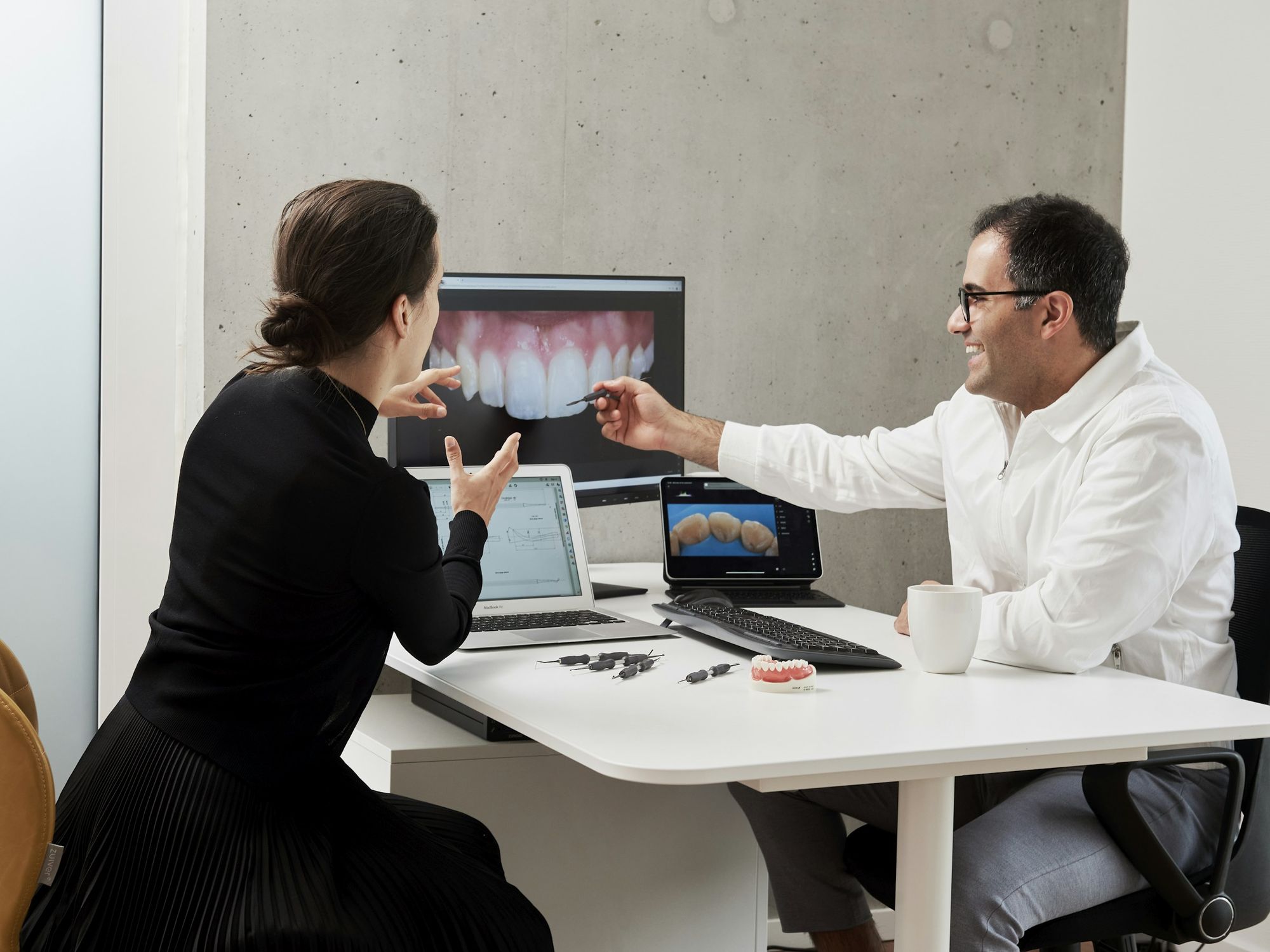
At Designer Smiles the pictures go up on the screen while the dentist explains them, and you leave with a written plan, each item priced from the fee guide, or with nothing to do until your next check-up, which is the most common outcome. Nothing starts until you agree to it. A new-patient examination is £27.90, the NHS Band 1 figure, and each routine examination after that is £27.90. What the check-up covers, and what is priced separately, is all on our check-ups page.
What does receding gums treatment cost?
Here is the whole ladder, simplest step first, with what each one is for.
| What it is for | The treatment | At Designer Smiles |
|---|---|---|
| Finding the cause | New-patient examination | £27.90 |
| Each check-up after that | Routine examination | £27.90 |
| Clearing plaque and tartar, treating gum disease | Hygiene visit | £70 |
| The same, without seeing a dentist first | Direct-access hygiene visit | £85 |
| Grinding at night | Soft night guard | £150 |
| A worn notch at the gum line | Glass ionomer filling | £76.60 |
| A dark triangle between front teeth | Composite bonding, per tooth | £200 – £250 on the current offer, usually £400 |
| A bare root that needs covering | Soft-tissue grafting, per site | £295 |
Most people’s treatment lives in the top few rows. You see, if gum disease is the leak under the fence post, the hygiene visit is the plumber. Plaque and tartar are removed along the gum line and between the teeth, gum disease is treated, and the way to keep your gums healthy at home is shown rather than told. For a hard brusher that last part is the cure, since a softer touch is far easier to learn with somebody showing you the angle. What a hygienist appointment involves has its own page.
Gum disease that has taken hold beneath the gums needs cleaning deeper, where a toothbrush never reaches: periodontal treatment, which the practice lists among its hygiene services, removes the bacteria that build up underneath the gums.
For grinding, the practice’s teeth grinding page puts it plainly: “Wearing a custom-made mouth guard from the dentist will help prevent damage caused by grinding or clenching.” A soft night guard sits between your teeth at night like a cushion, so the force lands on the guard instead of on the necks of your teeth.
A worn notch is filled, often with a glass ionomer filling, which the white fillings page describes as one “that releases fluoride”. Filling it smooths the ridge and covers the soft spot.
Where gum has drawn back between two front teeth, it can leave a small dark triangle. For a small gap, the bonding page describes the move exactly: “closed by widening the teeth either side a fraction.” Black triangles between teeth have a page of their own.
At the far end of the ladder, soft-tissue grafting is priced per site, among the other grafts on the implants page; who actually needs one comes further down.
Is it ever too late to save a tooth with receding gums?
Almost never too late to help, and the honest answer has two halves.
If “too late” means the gum growing back by itself, then it was too late from the very first millimetre, which is exactly why nobody aims for that. What dentistry aims for is stopping it, and stopping recession works at any stage, because the path and the leak can be dealt with whenever you find them.
The harder half is a single tooth that has lost most of what holds it. Back to the fence: a post that has lost most of its soil starts to wobble, and fresh turf on top won’t steady it. nhs.uk is plain that gum disease can lead to “your teeth becoming loose or falling out”, and that if it is serious, you may need “to have some teeth removed”. So a tooth that has lost most of its support may be beyond saving.
Here’s the kind part. One wobbly post doesn’t mean a falling fence. The teeth around it, with their soil still there, can be kept, and treating the cause is what keeps them. And if a tooth does go, the gap can be filled: a single dental implant at Designer Smiles is £1,700 including the crown.
Who actually needs a gum graft?
Fewer people than you might expect.
A gum graft, in general dentistry, is a patch. A small piece of soft tissue, usually taken from the roof of the mouth, is laid over the bare root and held with fine stitches, and over the following weeks it knits into the gum around it. It is the treatment that puts a covering back where gum has gone.
So it suits a root that is exposed and sensitive, or one where the gum left is so thin it is still drawing back, because covering the root protects it from the brush, the cold and the wear. It can suit a front tooth that now looks longer than its neighbour, too, if that bothers you.
Most receding gums, though, have drawn back a little, stopped, and sit there causing no trouble at all. That gum wants looking after, and a graft would be a lot of treatment for a problem that has already ended. The hygienist and a softer brush are the whole answer there. The examination is where you find out which one you are, and if a graft is right for your tooth, its figure is on your written plan before anything starts.
Where do you start with receding gums?
With a look, and nothing more dramatic than that.
On the NHS, nhs.uk says Band 1 can include “simple management of gum disease, such as scaling”, while our fee guide marks soft-tissue grafting as NHS work “only by hospital referral in limited cases”.
So there’s the whole picture. Receding gums don’t grow back, surgery is for the few whose bare root needs covering, and the gum you have today can be the gum you keep once whatever is wearing it back has stopped. Designer Smiles is at 4 Manor Square in the middle of Solihull: book online, ring 0121 709 3821, or message us on WhatsApp. If it has been years since your last visit, that is common, and nobody here is interested in telling you off.

