
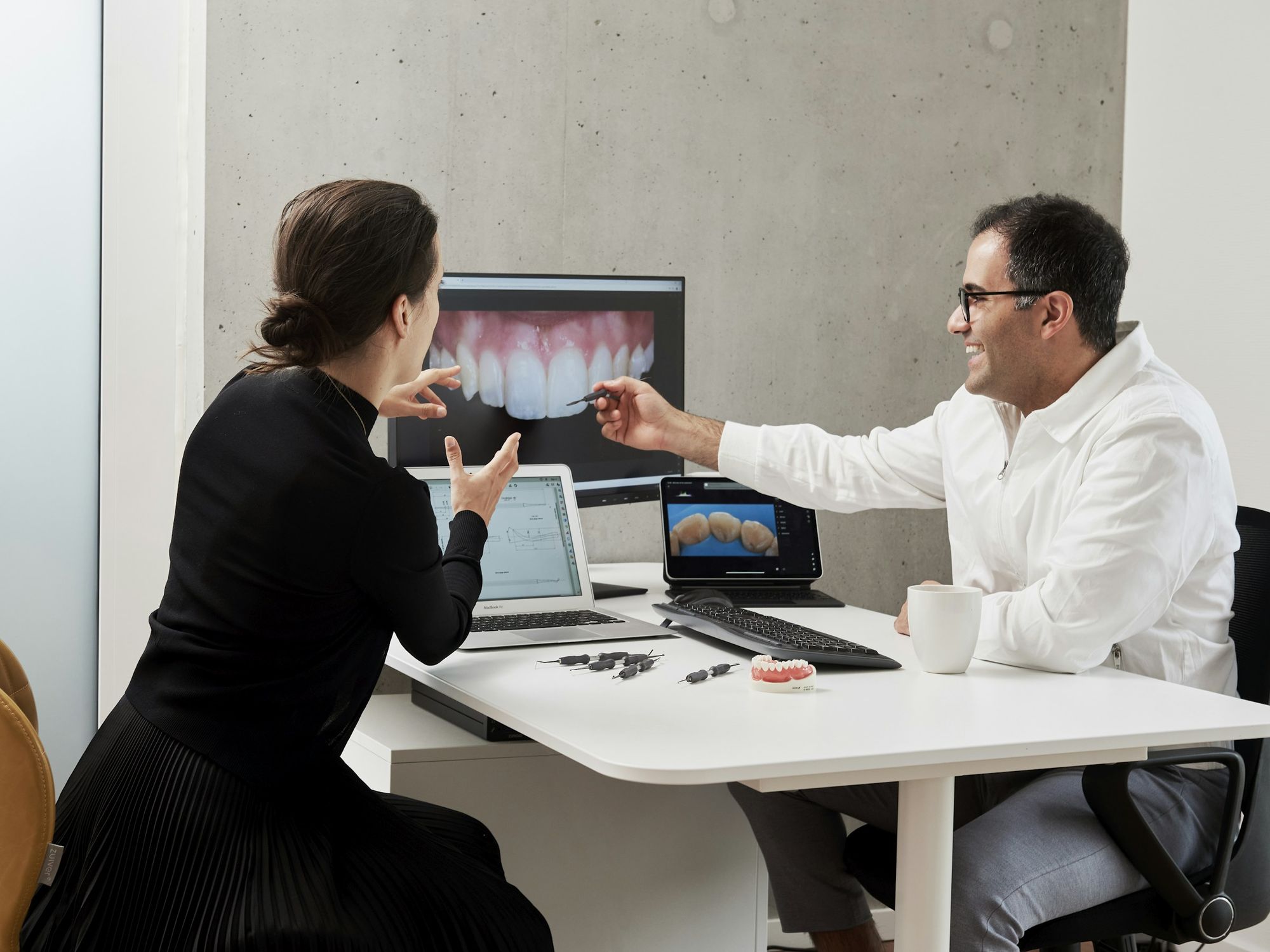
The hard stuff your toothbrush has been sliding over for years is the same sort of thing as the limescale in your kettle: minerals out of a liquid, set solid onto a surface. A hygienist appointment is somebody taking that off, and at Designer Smiles a hygiene visit is £70.
So what is a scale and polish, exactly?
Two jobs in one appointment, and the name tells you both of them.
The scaling is the removal of tartar, the hard chalky stuff that collects along the gum line and in the tight spaces between your teeth. It starts life as plaque, which is soft and comes away with a toothbrush. Leave it there a few days, though, and the minerals in your own saliva set into it, and now it is hard and stuck. You know how you cannot wipe limescale out of a kettle with a tea towel? Same idea. Tartar needs a tool, which is why nobody brushes their way out of it once it has arrived.
The polish is the bit at the end with the little spinning rubber cup and the gritty paste, which smooths the tooth and lifts the film of stain off the surface. It comes last for a reason: plaque clings to rough things the way dust clings to a fluffy jumper, so leaving the tooth smooth buys you time before the whole cycle starts over.
That is the scale and polish. A hygiene visit is the appointment it happens inside, and here that means a little more than a clean: plaque and tartar removed along the gum line and between the teeth, gum disease treated, bad breath and staining dealt with, and the way to keep your gums healthy at home shown to you rather than told to you. That last part is the one that changes anything, because plenty of people brush perfectly well and miss the same few places every day. Ten seconds in a mirror with somebody pointing at those places beats any amount of general advice.
How much is a hygienist appointment?
At Designer Smiles, £70 for a hygiene visit. Here is the whole hygiene side of our fee guide, so you can see it before you ring anybody.
| What you are booking | At Designer Smiles |
|---|---|
| Hygiene visit | £70 |
| Scale and polish with the dentist | £76.60 |
| Hygiene visit booked without seeing a dentist first | £85 |
| Airflow stain removal | £105 |
| A child’s hygiene visit | £35 |
Two of those rows are a clean from two different pairs of hands: the dentist while you are already in the chair for your check-up, or the hygienist in an appointment of its own, where the gums and your own technique get their turn too. Both figures sit in the open, so you know which one you are paying before you sit down.
And on the NHS? There is no NHS price for a hygienist, which catches people out. A scale and polish sits inside a Band 1 course of treatment, £27.90, along with the examination, the advice and any x-rays, and it is done when the dentist judges that you clinically need one. So it is not something you book because your teeth feel furry; it happens if it is needed, inside a course of treatment you were having anyway. The NHS charges sit beside ours treatment by treatment on their own page. And here is the plain version, which we would rather say now than have you find out later: if you are entitled to free NHS dental treatment, an NHS practice will cost you less than we do.
One more honest thing about the money. If gum disease has taken hold and the cleaning needs to go deeper, underneath the gum, that is a bigger job than a scale and polish, and it is planned and priced at your examination. It reaches you as a written figure you agree to, never as a surprise at the end of a cleaning appointment.
How long does a scale and polish take?
It depends on how much is there, which is true and fairly useless, so here is the useful version.
A routine clean, for somebody who has been having them, is usually well under an hour. There is not much on the teeth, so there is not much to do. The long one is the first appointment after a gap of several years, because there is more to take off and the gums underneath are tender, so the person cleaning them goes gently, and gently takes longer. Tartar below the gum line is a different job again, planned and priced at your examination, so nobody keeps you in the chair by surprise.
Hygienist or dentist: who does what?
Think of it like a car. Unromantic way to think about your own mouth, granted, but stay with me.
The dentist does the diagnosis and the repairs. They examine your teeth, your gums, the soft tissues in and around your mouth and your head and neck, take the x-rays, find the decay, and do the filling or the crown. The hygienist does the servicing that means fewer repairs: plaque and tartar off, gum disease treated, staining and bad breath sorted out, and your own technique improved so your mouth holds up between visits.
The split exists because gums are quiet. A tooth tells you when something is wrong, eventually, and it tells you loudly. Gums mostly do not, so it helps to have somebody whose whole job is looking after them.
At Designer Smiles your check-up is with Dr Aadam Binamin, Dr Uthmaan Binamin, Dr Abbaas Binamin, Dr Fareha Liaqat, Dr Hassan Khan or Dr Imtiaz Ahmed, and your hygiene visit is with Nowreen Akhtar or Humera Khan, the practice’s hygienists. Every dentist and hygienist is on the General Dental Council register, and the same fee guide applies whoever you see.
How often should I see the hygienist?
There is no universal number, and anyone who hands you one is guessing at your mouth from a distance. How quickly tartar builds up varies enormously: some of it is the chemistry of your own saliva, which you did not pick, and some of it is whatever your brushing keeps missing, which you can absolutely do something about.
Our membership plans give you the honest range, because they are built around one hygiene visit a year, or two, or four. Your dentist sets your check-up interval to your own mouth, anywhere from three months for active gum disease to two years for a healthy adult who looks after their teeth, and the same question decides how often you want a clean: what are your gums actually doing?
Does a scale and polish hurt?
For most people, no. It is scraping and buzzing and a rinse of cold water, and it feels strange rather than sore, and the strangeness stops the moment the appointment does. If one tooth is sensitive to cold, say so at the start rather than halfway through. You can stop at any point here, and the appointment goes better when the person doing it knows which corner of your mouth to treat gently.
Now, the bleeding, which worries people most and works almost backwards from how it feels.
Gums bleed during a clean when they were already inflamed before it started. Plaque along the gum line irritates the tissue, the body answers by sending more blood to the area, and the gum turns soft and red and full of tiny vessels sitting right at the surface. Touch it and it bleeds. It is a splinter in your finger: the finger is red and sore because of the splinter, and touching it only tells you the splinter is there.
So the bleeding is your gums reporting the state they were in when you walked in, and that is also why it stops. Take the plaque and tartar away, keep that edge clean for a week or two, and the inflammation goes down, the gum tightens back onto the tooth, and it stops bleeding at a touch.
Which gives you the one piece of advice that sounds wrong and is right: if your gums bleed when you brush, brush there more carefully rather than less. The bleeding is coming from the plaque you leave behind every time you flinch away from the sore bit.
What is Airflow, and is it worth the extra?
Airflow is a jet of water, air and a very fine powder, played across the tooth like a tiny pressure washer. It earns its place alongside the ordinary polish on reach alone: a spinning rubber cup is a fine tool on a flat, open surface and a hopeless one in the grooves of a back tooth or the narrow gap between two front teeth, which is precisely where coffee, tea, red wine and cigarettes like to park themselves. At Designer Smiles, Airflow stain removal is £105.
Is it worth it? It is, when the thing bothering you is colour sitting on top of your teeth. Surface stain lifts off, and what you get back is the colour your teeth already are, usually brighter than the one you have got used to seeing. It does not change the colour of the tooth underneath. If your teeth are not especially stained, the polish that comes with your hygiene visit is already doing that job, and you can keep your money.
Can I book a hygienist without seeing a dentist first?
Yes. It is called direct access, it means a hygienist can see you without a dentist sending you along, and at Designer Smiles a direct access hygiene visit is £85. Booked alongside your check-ups, a hygiene visit is £70.
It is a good door to come through when you know exactly what you want. Your last check-up was fine, your teeth feel furry, and you would rather not sit through an examination to get to the bit you came for. Book a hygiene visit at Designer Smiles and that is the appointment you get.
One honest limit. A hygienist is not a replacement for a check-up: cleaning and gums are their ground, while decay, the soft tissues of your mouth and the x-rays belong to the dentist. If the hygienist sees something a dentist ought to look at, they will say so.
And that is the whole of it. A hygiene visit at Designer Smiles is £70, we are at 4 Manor Square in the middle of Solihull, and you can book online at any hour or ring us on 0121 709 3821. If it has been years since anybody looked at your teeth, that is common, and nobody here is interested in telling you off.

