
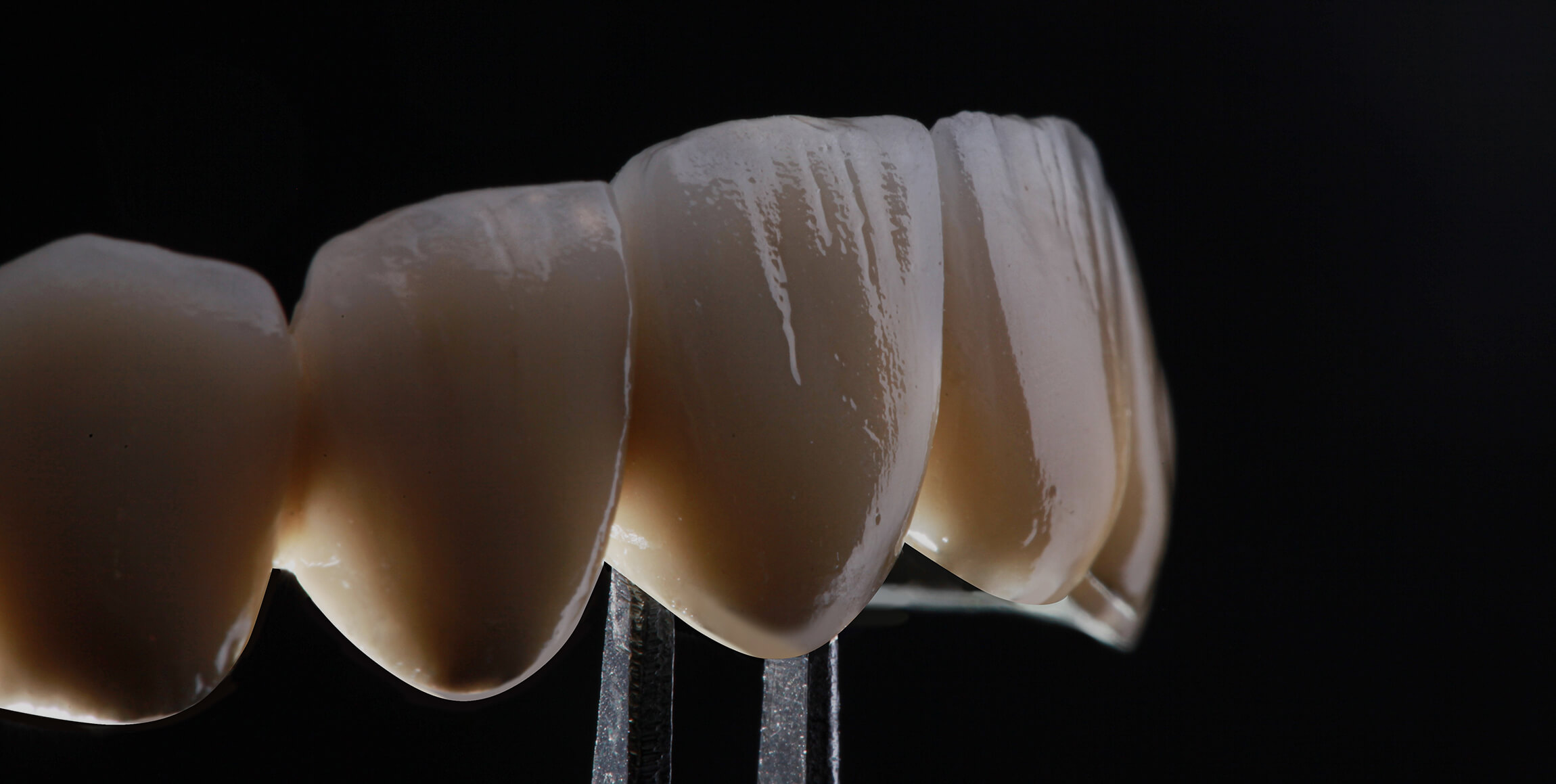
Whitening gel does nothing at all to a porcelain veneer, and that turns out to be the best news in this whole question. Porcelain keeps the shade it was made in and shrugs off the stains that slowly tint your own teeth, so once you know the order to do things in, a bright smile with veneers in it stays bright.
So, can you whiten veneers?
The veneers themselves, no. A porcelain veneer holds the shade it was given in the laboratory, and so does a crown. Only the natural teeth around them get lighter.
You see, whitening works from the inside of a tooth. The gel is a peroxide that soaks into enamel and breaks up the coloured molecules sitting within it, which is how the tooth itself goes lighter. Your enamel has spent years bathed in tea, coffee and everything else you love, and it has quietly soaked up a little colour from all of it. That is the colour the gel goes looking for.
Porcelain comes from somewhere else entirely. It is a glass-like ceramic, made in a laboratory to a scan of your mouth, with its shade chosen and fixed in it before it ever reaches you. There is no soaked-up colour inside for the gel to find. Our whitening page is plain about it: whitening “does nothing to porcelain, resin or metal”. And nhs.uk, on its own page about teeth whitening, agrees: “teeth whitening can only lighten the colour of natural teeth”.
Picture a china plate sitting on a linen tablecloth. Both have been at the same table through years of cups of tea. The tablecloth has slowly picked up a creamy tint, and the plate has stayed white, because anything spilt on it wiped straight off. Whitening is the laundry. It brings the tablecloth back beautifully, and it does nothing to the plate, because the plate never needed it. Your veneers are the plate.
Should you whiten your teeth before veneers?
Yes, whenever there is any chance you would like your teeth lighter. Whitening comes first, and the veneers are then made to your new shade.
Think about what happens the other way round. Veneers are made in the shade chosen against your other teeth, so they match your smile as it is on the day. Whiten after they are fitted, and your own teeth climb a few shades while the porcelain holds still, so your brand new veneers end up as the darkest teeth in your smile. That is why the whitening page is so firm about it: whitening comes before bonding or veneers, “never after”. Whitening first means the shade is chosen against the smile you are going to live with.
There is one small wrinkle worth knowing. Teeth tend to look their brightest in the days just after whitening and then settle back very slightly, so dentists commonly leave a little while before the veneer shade is chosen, and the porcelain is matched to the colour that stays.
At Designer Smiles, take-home whitening costs £200 on the current offer, half the usual £400, and that one fee covers the trays made to fit your teeth and the gel. Before any of that, a check-up makes sure your teeth and gums are healthy. The trays are then yours to wear at home for the time your dentist sets, with the colour lifting a little each day. The whitening page sets out each step, from the check-up to the trays at home.
Now the shape. Your veneers are designed on screen to your face, and then a trial smile goes over your own teeth, so you see the new shape in the mirror and can change it while nothing is yet made. After that, the laboratory makes your veneers in the shade you chose, so they sit in the row as though they grew there.
I already have veneers: can I still whiten my teeth?
You can, and for plenty of people it is exactly the right move. The question is which way the colour has drifted.
Most often it is your own teeth that have moved. Natural teeth slowly deepen in colour as the years go by, which the whitening page names as one of the most common reasons people ask about whitening at all. Porcelain does no such thing. So a veneer fitted to match years ago can now look a shade brighter than the teeth either side of it, and the row stops reading as one smile. That is the easy case. Whiten your natural teeth and they rise back up towards the veneers, and once the shades meet, the veneers stay exactly where they are.
Then there is the other wish: a whole smile lighter than your veneers have ever been. The whitening page answers that one directly: whitening “is planned around them, or they are replaced afterwards to match the new shade.” In other words, your natural teeth are whitened first, and any veneer that now looks darker than them is made again in the lighter shade. A porcelain veneer is £800 a tooth here, and the figure for your own smile is written down before anything starts.
The check-up before whitening is where you find out which of the two is yours, because your dentist looks at your own teeth there, right beside veneers that have not changed since the day they went on.
Why do veneers look yellow or dull after a few years?
This is the question that usually brings people here, and the answer is kinder than it feels when you catch your smile in a photo. Porcelain itself resists stain remarkably well, so when veneers look duller or yellower, the colour is usually somewhere other than inside the porcelain.
The first place it can sit is on the surface. Tea, coffee, red wine and plaque can leave a thin film on the glaze over time, the way a window picks up a haze you only notice when the sun hits it. That film comes off. A clean and polish at a check-up or a hygiene visit, £70 here, lifts it and lets the shine come back.
The second is the edges. Where a veneer meets your tooth there is a fine line, and stain can gather there just as it gathers along the grout between tiles. And if the gum has drawn back a little over the years, a sliver of natural tooth can show at the top of the veneer, and that natural tooth may have darkened while the porcelain beside it has not.
The third place is the teeth around them, which we met in the last section. Sometimes the veneers have not changed at all; your own teeth have, and the eye reads the whole smile as duller.
Now and then a dentist will see that the change sits underneath the porcelain instead, and then the kind answer is a fresh veneer. That is something only a dentist can tell by looking, which is the whole reason to have it looked at before you spend anything. Shop whitening kits and whitening toothpastes cannot lighten porcelain any more than a dentist’s gel can, so the fix for a dull veneer starts in the dentist’s chair.
What about composite veneers?
Composite veneers are composite bonding by another name, a tooth-coloured resin sculpted straight onto the tooth, and they behave a little differently. Whitening leaves resin the shade it was made in too, just like porcelain. The difference is stain. In the bonding page’s own words, “Tea, coffee and red wine stain resin a little faster than enamel over the years, which a polish lifts.”
So a composite veneer that has gone a little dull is usually polished back, and one you would like lighter is redone in the new shade after your teeth are whitened. Whitening with composite bonding walks through that whole story, and composite bonding against veneers sets the two materials side by side if you are still choosing.
What happens to veneers after ten years?
Often, very little. Porcelain veneers last ten to fifteen years, so at the ten-year mark many are still going well, and still the shade they were on the day they went on. The things that shorten a veneer’s life are the same things that damage teeth: grinding, biting hard things, and gums left uncleaned around the edges.
When a veneer does reach the end of its years, it is replaced with a new one, made to your smile as it is then. And here is the happy bit: it is the perfect moment to whiten first. Your natural teeth go lighter, the new veneer is made to match, and your smile comes out of the replacement brighter than it went in. How long veneers last covers the years themselves, and what ends one, and what veneers cost over the years works through the replacements.
So what keeps veneers bright?
Mostly, the order you do things in. Whiten your natural teeth first, then have your veneers made to the new shade, and porcelain will hold that shade for the ten to fifteen years it lasts. If your own teeth drift darker beside them, whitening can bring them back up towards the veneers. If the veneers look dull, a polish at your check-up lifts the surface stain. And if one has reached the end of its years, it is replaced, ideally after whitening, so the new one is made to your lightest shade.
At Designer Smiles, veneers are planned on a 3D scan, designed on screen to your face, and tried on your own teeth as a trial smile before anything is made, at £800 a tooth with the figure written down before anything starts. How veneers are designed, tried and fitted here is on the crowns and veneers page. The smile design consultation, with the 3D face and teeth scan, is free and held with a refundable deposit. You will find us at 4 Manor Square in Solihull, on 0121 709 3821, and whether you bring veneers you already have or plans for new ones, we will look at the shade with you.

